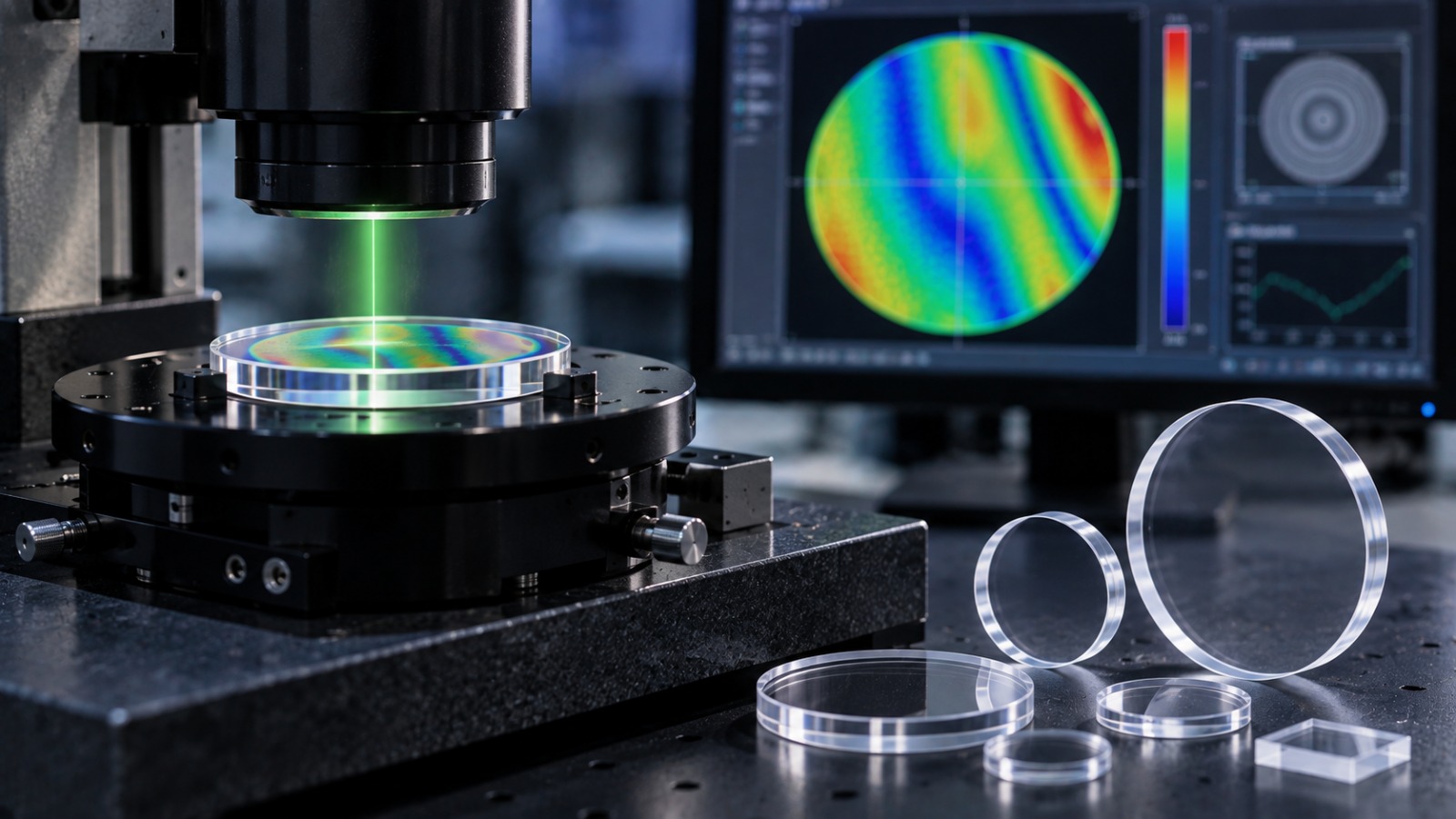
Sapphire is extremely hard — and that is exactly what makes high-precision polishing challenging.
For standard protective windows, moderate flatness may be sufficient. But in demanding optical systems, surface flatness up to λ/10 can be critical for minimizing wavefront distortion and maintaining optical performance.
Achieving λ/10 on sapphire requires careful control throughout the manufacturing process:
• Material quality — internal stress and crystal quality matter
• Precision grinding — geometry must be controlled before final polishing
• Polishing process — sapphire's Mohs 9 hardness makes material removal slow and demanding
• Thickness & parallelism — especially important for precision optical windows
• Final inspection — interferometric measurement verifies the finished surface
The tighter the optical specification, the more important stable process control becomes.
At COE Optics, we manufacture custom sapphire windows for applications ranging from industrial protection to precision laser and optical systems.
Sometimes a sapphire window is more than a protective cover — it becomes part of the optical system itself.
Need high-flatness sapphire windows for your application? Send us your drawing or specifications and let's discuss the right manufacturing solution.