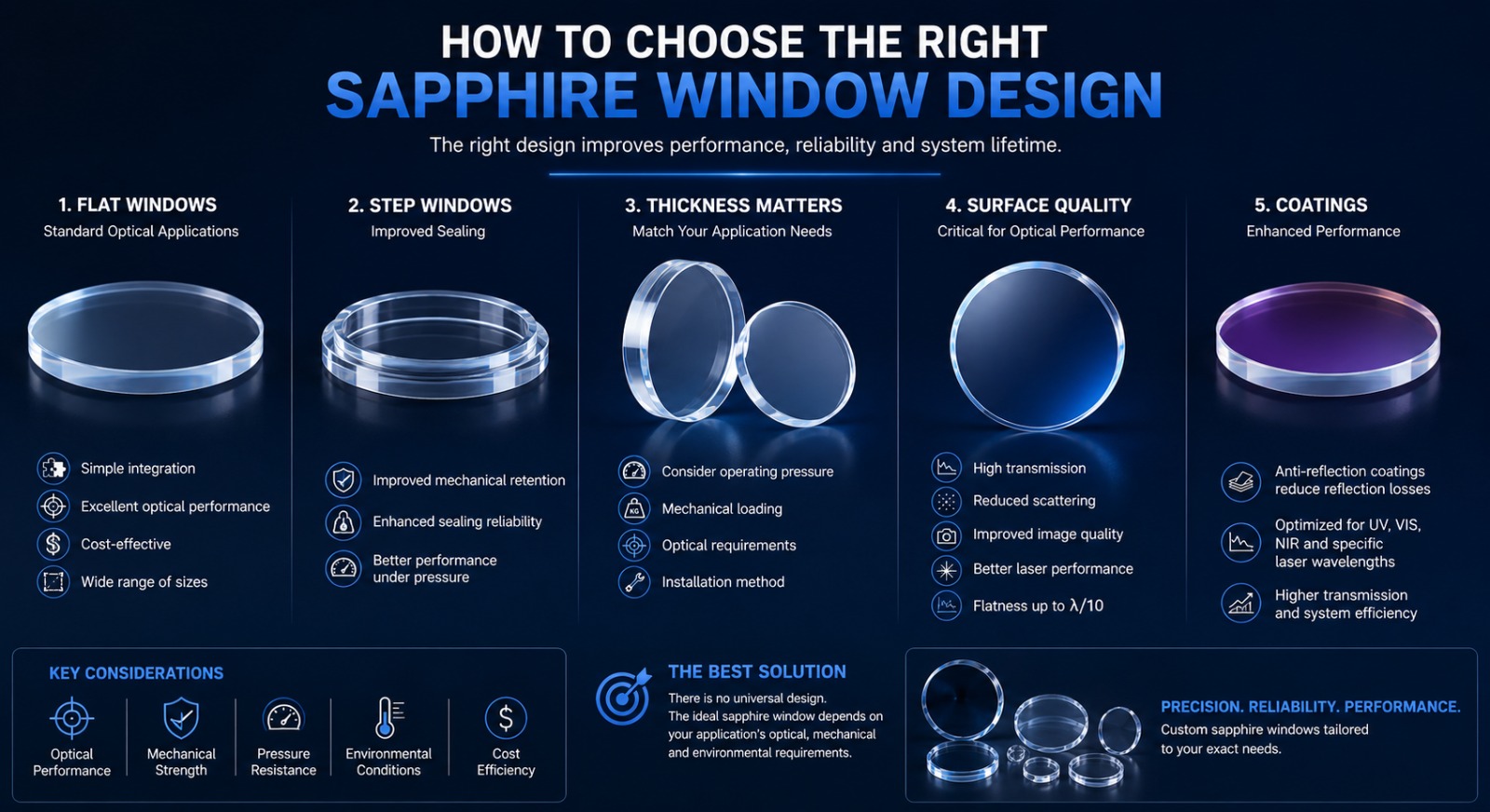
Selecting the right sapphire window is about more than choosing a material. The window design can directly affect optical performance, mechanical strength, sealing reliability, and overall system lifetime.
When designing an optical system, several factors should be considered.
Flat sapphire windows are the most common configuration.
They are typically used in:
Advantages:
For many applications, a flat window provides the ideal balance between performance and cost.
In harsh environments, sealing becomes critical.
Step sapphire windows incorporate a shoulder that helps position the window and improve sealing performance.
They are commonly used in:
Advantages:
When pressure resistance is important, a step window is often the preferred solution.
Window thickness should be selected according to:
A thicker window generally offers higher strength, while a thinner window may reduce weight and improve transmission.
Finding the right balance is essential.
For high-precision optical systems, surface quality plays a critical role.
High-quality sapphire windows can provide:
For demanding applications, surface flatness up to λ/10 may be required.
Anti-reflection coatings can further improve transmission and reduce reflection losses.
Depending on the application, coatings can be optimized for:
The coating design should always match the operating wavelength range.
There is no universal sapphire window design.
The best solution depends on the application's optical, mechanical, and environmental requirements.
By selecting the right combination of window geometry, thickness, surface quality, and coating, engineers can maximize both performance and reliability.
Have a project in mind? Contact us to explore custom sapphire window solutions tailored to your application.